Most people meet heart rate variability as a single number on a watch face, and most people immediately do the wrong thing with it: they compare today to yesterday and conclude something about their body.
The number is real. The comparison is not very useful.
What HRV actually measures#
HRV is the variation in time between consecutive heartbeats. A heart that beats at exactly the same interval every time is a heart under load. Healthy autonomic regulation produces variation, because the parasympathetic and sympathetic branches are constantly negotiating.
That negotiation responds to nearly everything:
- sleep duration and, more strongly, sleep timing
- alcohol, even one drink, even hours earlier
- training load from the previous 48 hours
- illness, often a day before symptoms appear
- ambient temperature and hydration
- psychological stress, including anticipation
A single morning reading is the sum of all of those at once. Treating it as a verdict on your training is like reading one frame of a film.
Read the band, not the point#
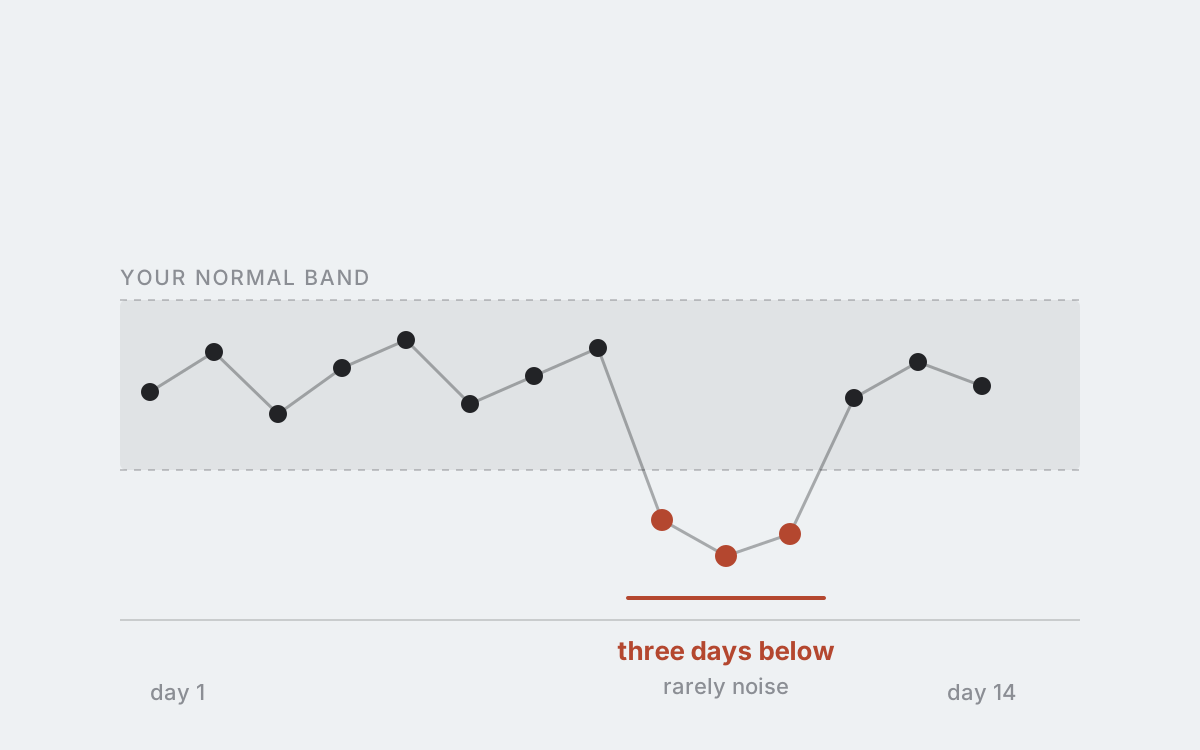
The useful signal is where today sits relative to your own recent distribution, not relative to yesterday and definitely not relative to someone else. Two people can differ by 80 milliseconds and both be perfectly healthy.
A workable reading:
| Position vs your baseline | Reasonable interpretation |
|---|---|
| Inside your normal band | No signal. Train as planned. |
| Below band, one day | Something happened yesterday. Look for it. |
| Below band, three days | A real stressor is unresolved. |
| Above band, sustained | Adaptation, or a fresh drop in training load. |
Why three days matters#
One day below your band is noise often enough that acting on it costs you more than ignoring it. Three consecutive days is rarely noise. That is the point where the question shifts from "what did I do yesterday" to "what am I not recovering from".
The practical version#
- Measure at the same point in the cycle every day. Overnight averages beat spot readings, because they are less sensitive to when you woke.
- Ignore absolute comparisons to other people entirely.
- Give any change three days before you act on it.
- When it drops, look for the cause before changing your training. The cause is usually in the previous 24 hours and usually obvious once you look.
HRV is at its best when it makes you ask a question you would otherwise have skipped. It is at its worst when it answers a question it cannot actually answer.